Godspeed New ! Genres and Mastodon
Another year, another slew of advertising campaigns masquerading as year-end summaries, and another blog post in protest from me.
Here are all items I've published
Another year, another slew of advertising campaigns masquerading as year-end summaries, and another blog post in protest from me.
So I don’t like “AI”, for various reasons. One being that the AI companies seem intent on destroying the internet by ingesting the things people have made and spitting out slop everywhere.(sidenote: For the latest example: https://pod.geraspora.de/posts/173421631 ) Garbage in, garbage out. Well I don’t want them to do that to my stuff too, so I want to make sure that if they want to soullessly gobble up what I’ve written, they will at least have to do some manual effort. By poisoning my site with garbage data it will become less valuable to these scrapers. Hopefully it will not detract for human visitors.
My distaste for the company Spotify has steadily grown over the years. It started with an annoyance over relying on a proprietary app for music, but since I stopped using the app my supply of distaste has come from the company’s hate for musicians. (sidenote: See this article for the latest example. ) With the Spotify Wrapped they’ve come up with a new way to get free advertising, and it has become hard for me to avoid the company.
Many who are into philosophy, myself included, like to make fun of famous scientists for not understanding it. It is the classic phenomena of experts in one field making bad statements about a field they aren’t familiar with.(sidenote: There’s even some philosophy about it: “Experts, Public Policy, and the Question of Trust”.1 )
When someone like Stephen Hawking says that “Scientists have become the bearers of the torch of discovery in our quest for knowledge” and that “Philosophy is dead”, I can’t help but wonder if his conception of philosophy is stuck in ancient Greece, when what we call philosophy and science were more closely linked together, when philosophers made unhinged statements about the physical nature of the world without any empiric evidence. This despite the fact so much has happened in the field since, and that contemporary philosophy is investigating so many important questions that are very much relevant to us today. Political philosophers build knowledge around how we should govern ourselves; critical disability theory aims to interrogate the social norms that define disability; queer theory investigates the social and cultural phenomena of gender and sexuality; postcolonial studies seeks to understand how colonialism and imperialism continues to affect the world. The list goes on. These are often interdisciplinary fields that often include both the social and natural sciences. Philosophy is even important for science itself, as questions of how science is and should be conducted are key topics in philosophy of science. It is not something that can be solved through gathering empiric evidence.
In How Jordan Peterson’s Suits Taught Me Fashion, CJ the X talks about libertarianism in a way I haven’t seen before. The video is about how fashion works as a means of communication, specifically how it communicates what groups you belong to. To overly simplify, it chronicles a history of fashion in the west (based on Derek Guy’s account) in three stages. In the first stage there is an objective understanding of beauty, the elites and nobles have an innate sense of beauty that the masses just don’t have. The closer you are able to dress like the nobles, the better you are at fashion. Fashion is used to signal proximity to the nobles. The second stage is the modern stage, where there are many groups, and fashion is here used to communicate which groups you have allegiances with (think greasers, punks, goths, hippies, but also college professor, tech bro, CEO etc.). Each group dresses according to a unspoken rule set, dictated by the prominent members of the group. The third stage, the postmodern stage, says that the modern fashion didn’t go far enough in liberating people. Being dictated by which group you belong to is still to be in chains. Postmodern fashion is an example of libertarian culture that puts the individual on a pedestal over everything else.
In Sabine Hossenfelder is WRONG About Capitalism, Unlearning Economics (UE) criticizes Hossenfelder for getting the history completely wrong. In order to explain money, she makes up a fantasy society that functions exactly like ours, except it doesn’t have money. That of course makes it very inconvenient to not have money, so it would be natural for them to invent money. This is basically a circular argument that doesn’t take history into account at all, how money actually came to be (UE refers to Debt: The first 5000 years by David Graeber)(sidenote: Everyday Anarchism has an excellent read-through series on Debt: https://www.everydayanarchism.com/david-graebers-debt/1 ) and the many societies that didn’t have money, or used them in very different ways.
Usually when I write a review, I try to talk about specific things that make the thing I’m recommending unique or interesting. I don’t want to resort to platitudes and very general statements like “engrossing”, “excellent prose” or “gripping plot”, because that you can say about almost any book you like. The reason I started reading Malazan for example, is because someone said that they are epic fantasy books that are written like short stories. That caught my interest so I started reading them. With Momo by Michael Ende however, I have a harder time articulating myself. I feel like I can only talk in general terms if I don’t want to spoil too much. I don’t know how else to recommend this book than to say that it is an engrossing story, that the prose is excellent, the plot gripping, and the themes profound. Sometimes a book is just good in ways that are cliche to describe, without being cliche itself.
This contains spoilers for the first season of Haikyuu. I have tried to hide the concrete stuff behind spoiler bars (that work when viewed from a web browser), but the text still deals with some core themes.
C. Thi Nguyen uses a distinction between achievement games and striving games. Achievement games are games where the reason why you’re playing the game is because you want to achieve the goals of the game. Striving games are games where you don’t care about the goal, but you are interested in the activity of playing the game itself. Most party games are striving games, where the goal isn’t to win, but the fun you have with your friends while trying to win. Another hallmark of striving games is that when two players are evenly matched, neither player tries to take shortcuts to improve (like a strategy guide), because then they would be unevenly matched and the activity of playing wouldn’t be as fun anymore, even though that player would be more likely to win.
I listen to a lot of podcasts, maybe too many. I often want to share the episodes with friends, but it’s a bit tricky to do that with podcasts. I can send a link, but there are so many places to host podcasts on that it becomes a bit messy. And on the receiving side its also nicer to be able to listen to podcasts in your podcast player, which you can’t do if you get just a single podcast episode linked to you. But if I have a feed with all of my favourite episodes that becomes easy, they just have to subscribe to it. So now I am a podcast curator, you can find the feed here. Just put it into your podcast player like any other RSS link.
Idag var jag ute på en nattpromenad. Jag svängde in på ett typiskt villaområde som hade vanliga bilvägar och smala trotoarkanter. Om det här var en scen som utspelade sig för några år sen så hade jag valt trottoaren här, men idag så började jag istället fundera på varför jag var så ovillig att vistas på bilvägen.
Den första instinkten jag hade var att det är moraliskt korrekt att göra så. Att gå på vägen vore att bryta mot reglerna, regler som finns där för att underlätta för trafik och se till att vi inte är i vägen för varandra. I vissa situationer så kanske det stämmer, men i det här villaområdet så var det väldigt tomt på bilar. Jag var inte i vägen för någon genom att gå på det här relativt öppna området. Det kändes väldigt konstigt att jag skulle behöva gå på den väldigt smala trottoaren när det fanns så mycket utrymme där på bilgatan. Jag kanske var i vägen för några spökbilar? Vem är det egentligen som är i vägen för vem? Jag, som är en person bred, eller bilarna, som är fyra? Det är inte bilen som förvisats till vägkanten, som måste gå precis intill de mer eller mindre vältrimmade buskarna och undvika de utstickande grenarna. Bilismen är så inpräntad i samhället att det inte ens behöver vara några bilar närvarande för att de ska kunna ta utrymme i anspråk. Vi fotgängare ger lydigt utrymmet även till spökbilarna.
I think these thoughts are in some way a response to sentiments expressed in this Existential Comics: https://existentialcomics.com/comic/537. Basically it argues that magic in stories (that follows deterministic rules) isn’t really magic, it is just different physics since it is just how that world works. I don’t want to refute it because it makes sense to me when talking about the world; if people learned to make things levitate it wouldn’t be supernatural because it is actually happening in our natural world.
I’m doing a Link Party! The theme for this party is planned obsolescence and how we relate to the future.
by Unlearning Economics: https://www.youtube.com/watch?v=Fz68ILyuWtA
I’ve already summarized this one fairly thoroughly before, but it’s such a good introduction to planned obsolescence that it’s worth sharing again. This video is a great examination of planned obsolescence from an point of view of an economist, and finishes off by turning the criticism against capitalism. Many leftists youtubers can be a bit loosy goosy when it comes to critiquing capitalism as an economic system (mostly because most of them aren’t trained in economics), which UE criticizes fairly. This one feels more rigorous, and ties planned obsolescence directly to the core of capitalism. He argues it isn’t just something you can regulate away, and if you could it would hurt the economy in a major way and cause many to loose their jobs. Therefore within the capitalist system we have a vested interest preserving planned obsolescence (and capitalism). Planned obsolescence isn’t happening because of a bug of capitalism, it is happening because capitalism is working
English below.
Okej, det här blir första gången jag ger mig in på blandbandsfredag! Temat är låtar av (klassiska) (hård)rocksband som står ut från resten av deras låtar. Inspirationen är att när jag försökte ta mig in i genren för några år sedan var det ganska ofta jag hitttade en låt som jag gillade, men att resten av bandets musik inte klickade alls. Det verkar finnas en trend av att banden gör en låt som är mycket längre än deras andra, och att de står över dem andra i dramatik och möjligen också kvalité.
Today I want to recommend the short story collection Changing Planes by Ursula Le Guin. It centers around a theme of world building, where she visits a new world with new societal structures for each story. Really, it is almost like it is a peak into her creative process as it feels like she is playing around with ideas and worlds, exploring them to see what kind of stories they contain. This might just be how she comes up with the fantastic worlds in her other novels.
This contains spoilers for the plot of the movie Shoplifters and what the later episodes of Neon Genesis Evangelion looks like.
In Recommending Shoplifters I wrote that we as audience are trapped together with the mother in the interrogation scene towards the end. I think I really like things like that, where I’m trapped by the movie to sit through an intense and complex web of emotions. Neon Genesis Evangelion does that too with its last two episodes. I don’t know what was going on or really what emotions to feel, but I felt them intensely. I felt like I couldn’t move, shouldn’t move, that I had an obligation to pour my undivided focus to whatever was happening on screen. I think the Shoplifters scene was much clearer for me in terms of the legibility of emotions, but I felt trapped in the same way. This is a scene where I should shut up and watch.
Today I’m recommending the movie Shoplifters by Kore-eda. The first bit is spoiler-free.
A friend of mine described Shoplifters as being very human (“väldigt mänsklig” på svenska), which I think is apt. It is a story that feels more relaxed in a way that makes me feel like the characters are regular human beings, rather characters in a story. They are there on the screen, and we follow them around, but they don’t tell us everything they think or why they do the things they do — just like real people. Not everything is resolved, and some things are left a complicated tangle — just like real life.
Productivity apps are scary. Some days you find one that looks interesting, and so you decide to play around with it to see how it works. From a first glance, it might actually be something that fits you perfectly, but you can’t quite tell from just the documentation, so you have to download it and try it out for real. It will only be a short-term thing, you tell yourself. An hour tops, you tell yourself. And that’s when they get you. Before you know it you’ve spent the entire day totally obsessed with testing different configurations, seeing how they fit with the rest of your workflows. The productivity demon will keep you from eating your food and makes you ignore the various aches that are spreading throughout your body, a body that hasn’t been able to move away from the computer since you started. Even if you manage to wrestle your body away your mind is still held hostage. “But what if I tried that? Wouldn’t that be neat?” Before you know it, you find your body before the computer once again, desperately trying to appease the demon. Even as it dawns on you that no, even if you could make this work, the cost of transitioning over would definitely not be worth it — your mind refuses to let go. Desperately it tries to get the demon’s attention again. When, at last, you break free, you realise that this would never have fit (fut?) from the start. But that would be admitting that you have wasted so much time, so you try to convince yourself that this was actually a pleasant experience. You actually had fun doing it. It is your hobby after all. It was your free choice. But deep down, you know, that once again you briefly lost your soul to the productivity demon.

A couple of years ago, zettelkastens and backlink-based note-taking applications that emphasize many interlinked notes became popular as the idea of zettelkastens became popular again. At least in the areas of the internet I frequent. I also jumped on the trend and started using one, which eventually became this blog: https://a-blog-with.relevant-information.com/posts/introducing_this_blog_thing/
I like plaintext stuff, partly because it makes everything very transparent. I can see the effect of an operation very clearly, and can do any manual intervention I like. For my slip-boxed note-taking software needs I use org-roam, which uses the plaintext format org-mode as the single source of truth, while using a sqlite database as a cache to speed things up.
Sousou no Frieren is a very trope heavy story. The world of Frieren could be from basically any isekai or JRPG of the last decade. There is the party that defeats the demon lord (there is a demon lord), with the bearded dwarf warrior, the mage elf, the human priest, and the Hero. The setting mostly consists of classic medieval Europe inspired towns and villages, or generic forests and plains. At least it doesn’t have a RPG game system, but the magic itself is also pretty bland. It’s the same old magic circles that appear when one is doing magic, and the magic does a bunch of arbitrary things. The plot is basically the party travelling towards the demon lord’s land while doing a bunch of side quests.
Today I want to write a blog post about my recent experiences with journaling. There are two reasons: 1) is that I feel like it has helped me with writer’s block so I want to share it, and two is that it is interesting and kind of funny that I got help from the novel Piranesi. I want to do it in a bit of a meta style, where I showcase what it is I’m doing by doing it, what I’m doing right now in other words. The reader will probably be confused when reading this, but I hope the reader understands the demonstration that is this paragraph when I’ve explained it down in the main text. This isn’t just because it is funny (although it is), but also because I think it’s hard to explain so having an example helps. First I want to introduce the book, because it seems like a good introduction and it’s a good way to ease into the topic. Then I want to do a brief chronological summary of how my current system came to be. The indexing from Piranesi became relevant when I wrote my thesis, because I realized I wouldn’t be able to keep track of the plans I was making for the thesis. It was great to be able to write down plans that were frozen in time, but I thought it would be hard to keep track of all the plans, so I needed to have a system for organizing them. Indexing turned out to be a great fit because it is a system that is applied from the outside and doesn’t disturb the benefits of journaling.
If there’s one music recommendation I would give it would be the band The Dear Hunter. I don’t really know the genre words to describe them, but Wikipedia calls them a prog rock band. It’s really hard to pin them down since they are constantly changing. Their latest album for example, Antimai, is much more funky than the rest which took me aback. If you end up listening to this band I welcome recommendations for stuff that is similar. I crave more.
I just read an article, The average AI criticism has gotten lazy, and that’s dangerous - Redeem Tomorrow, whose proposed solution to the AI situation is for everyone to have access to their own pattern synthesizer (their neologism for “AI”), instead of just a handful of companies controlling them. In some sense that is good, it would avoid enshittification I think. They argue this because there isn’t a way to remove the synthesizers from existence, since they only need commodity computing hardware to be produced. The process is well documented and broadly available. Limiting the availability of the knowledge and/or hardware isn’t something we’re willing/should be willing to do.
Today’s plan was to post an old rant of mine, maybe doing some light editing to brush it up. I went through my notes to read it over, and it turns out I actually have more things to say than what is in the rant. I felt like I had written more about it in my notes, and sure enough, there is enough to turn it into a proper essay. Some day I will finish it up and publish on the Slog. There are some things in here that I don’t agree with anymore, but I still think it’s worth sharing, so for now, here is the rant:
Today’s link is from Low Tech Magazine. I like this magazine because it challenges my assumptions on what kinds of technology is harmful and what kinds of technology is necessary. A throughline of the magazine is that it takes a low tech angle on various topics, informed by the goal of environmental sustainability. The article I want to talk about is called Keeping some of the lights on: Redefining energy security.(sidenote: Archive link: https://web.archive.org/web/20240101140756/https://solar.lowtechmagazine.com/2018/12/keeping-some-of-the-lights-on-redefining-energy-security/1 )
Today’s link is a philosophy paper. Don’t let that scare you though, it doesn’t really fit into the stereotypical notion of philosophy. This is a paper about philosophy of games (what makes something a game and how do we interact with them?) as applied to communication. It is incredibly accessible to read and easy to understand. The paper by C. Thi Nguyen is called How Twitter Gamifies Communication, and is about, well, how Twitter, and really any other social media with a point system, gamifies communication “by offering immediate, vivid, and quantified evaluations of one’s conversational success”.(sidenote: If you prefer podcasts as a medium, you can check this episode of the Ezra Klein podcast.1 ) As a side note, notice that this isn’t directly about recommendation algorithms, but of point systems like likes, retweets, followers, or views.
Today I want to write about writing, specifically writing practices with a common place book. The links for today are pretty similar so you can read one or the other, or both — they are still different to each other.
The core of Cory Doctorow’s writing method (the “Memex method”) is to write a blog post every day. This of course becomes really good practice for writing, as expressing what you want becomes easier and easier the more you write. He claims this has helped him a lot in his novel writing, which is remarkable to me as it is a completely different genre of writing. In order to have things to write about every day he goes through the websites and articles he’s recently read, and his own blog posts from the same day 1, 5, 10, and 15 years ago. From that he writes the day’s blog post.
by Unlearning Economics: https://www.youtube.com/watch?v=Fz68ILyuWtA
An interesting video outlining the economics of planned obsolescence and what the problems are (beyond making us feel ripped off.) It concludes with, as far as I can tell, a solid argument against capitlism.
In summary, he argues that planned obsolescence isn’t a bug of capitalism, it is happening because capitalism is working. It’s caused by companies wanting to make profit in a competitive environment. It is a phenomenon that is clearly not happening in just one part of the economy, but has been happening for a long time in virtually every sector. Even Henry Ford, an industrialist with a monopolistic grip on the market and a conviction that cars should last for as long as possible had to give in to perceived obsolescence by making new models with largely cosmetic changes which would make older models seem obsolete.
This is short story collection centred around norm breaking. Ideally you should read this collection with as little information as possible, so I will list some interesting things about it behind spoiler tags so you can choose how much you know before you feel like it’s enough. Some content warnings: but I recommend it partly because it’s good at shocking the system by shifting around what is considered normal.
https://www.brandonsanderson.com/outside/
In this heart warming essay on about why he writes, Brandon Sanderson says that he does it in order to let more people inside, to somewhere they feel like they belong. It is then not surprising that he writes in a way such that the prose doesn’t get in the way, he wants more people who feel left out to find a place where they can feel like they belong.
En dikt
Phenomenology is the study of the phenomena we experience. Taking a step back from the way we normally perceive the world, the filters and abstractions that make it possible to live in it, phenomenologists try to perceive the information their senses provide as directly as possible. This makes it a very subjective study with findings that are hard to generalize, and that’s part of the point. How boring wouldn’t it be to live based solely on generalizable undisputed facts? Phenomenology is one of many ways to produce knowledge that isn’t trying to be objective.
My thoughts after reading half of the Malazan Book of the Fallen series
A poem about abstraction
It was the second spring of the year, or perhaps third. I can’t remember. Where I live the transition from winter to spring doesn’t go smoothly, it is a tug of war and spring has to try multiple times in order to succeed. (sidenote: This was not the last spring of the year. In a feint to tug at our collective hearts, the spring decided to yield to winter one last time. Only days after it was snowing again and temperature dropped down to -8 ℃. I had foolishly put my trust in the weather and biked to school in spring clothing. That was a mistake I will surely make again.1 ) In any case, a combination of switching to summer time and good weather meant that the sun shined brighter compared to before, the contrast making me feel like I was newly awake. When I think back to the days before it is as if I saw the world through a black veil, and only now had I taken it off. The sky was intensely, almost imposingly blue, and the snow was mostly white without much slush. Pristine early Swedish spring.
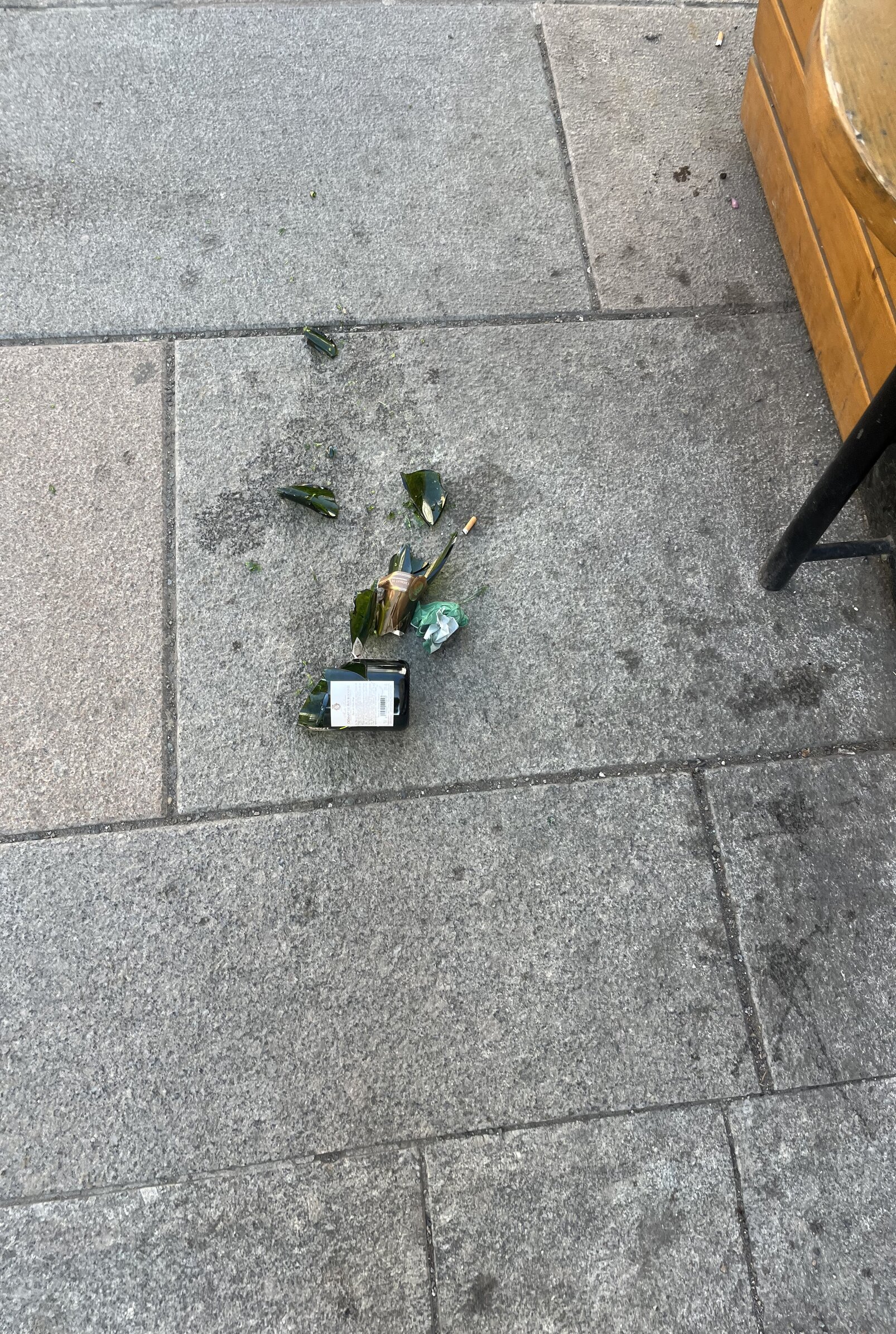
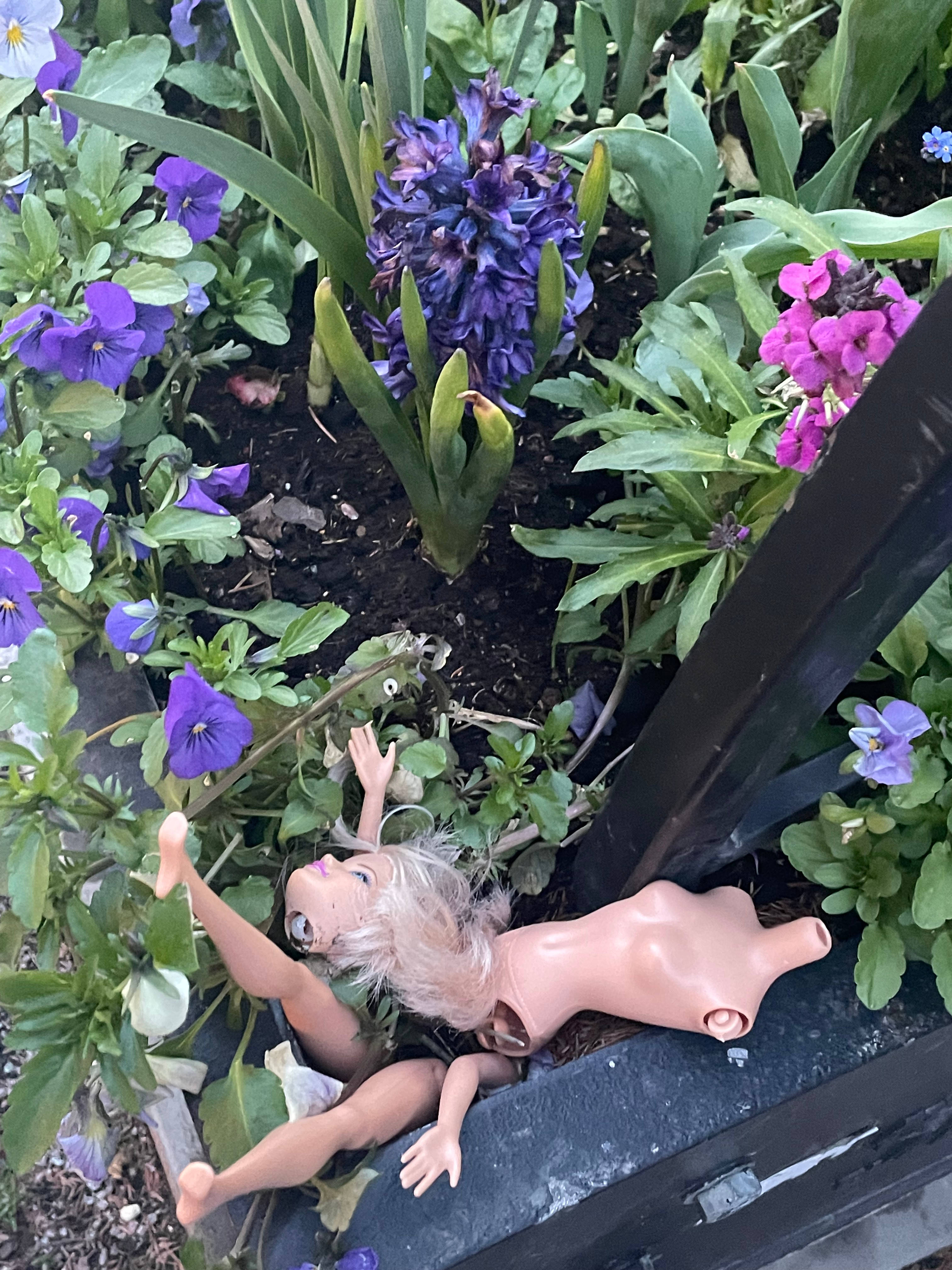
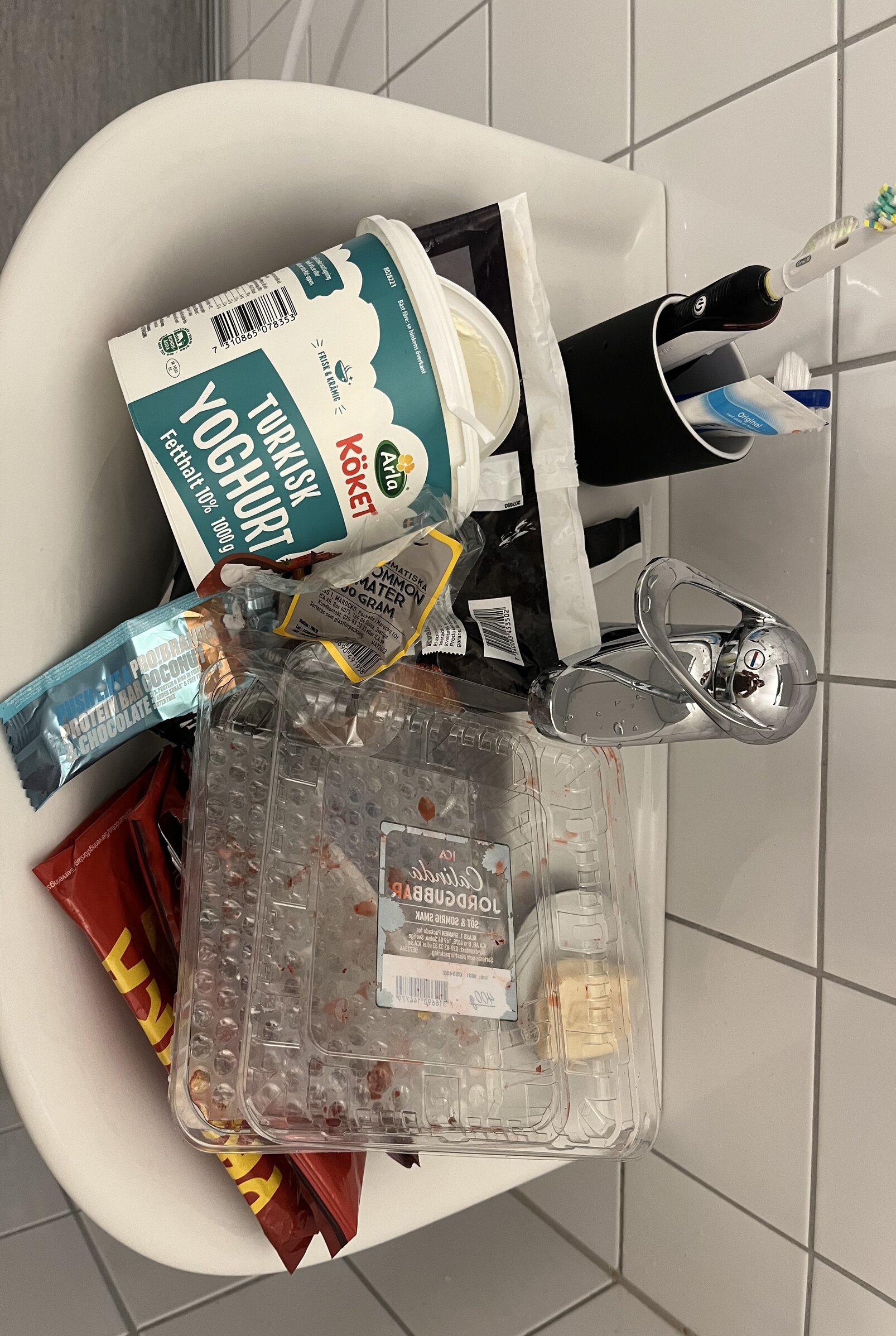
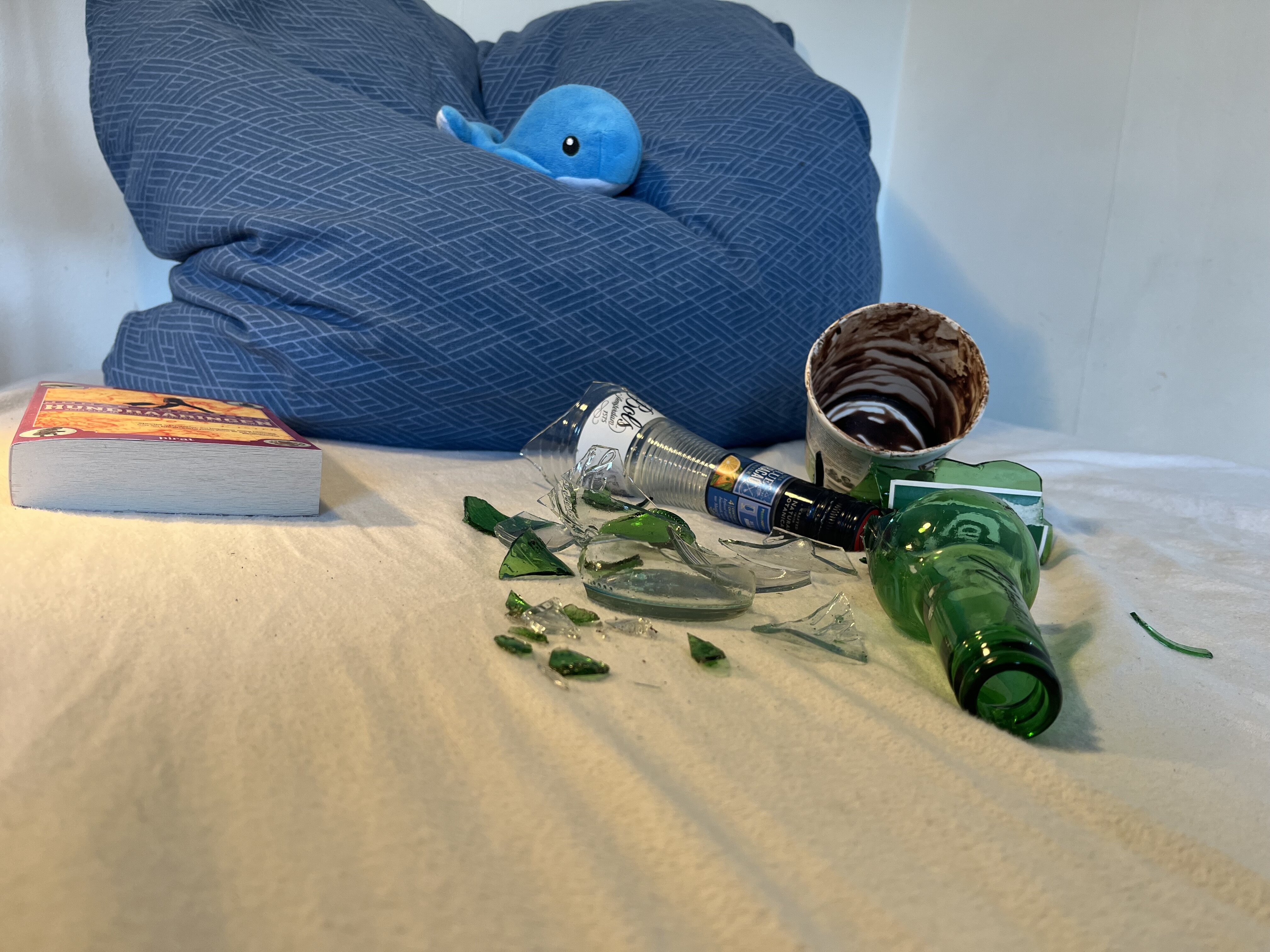
How much trash do we produce every day?
How and where do we notice trash?
When do we find trash disgusting?
How could we become more conscious?
And, finally: What is trash at all?
A poem about traffic lights
A poem about ice
Nassim Taleb often says crazy things (like saying that mathematics is bad because economists misuse it), but sometimes he says something useful. One such thing is the Antilibrary: the collection of books in your library that you haven’t read. He values these books more than the read books because they are a reminder of how much you don’t know, a form of intellectual humility before the copious amount of knowledge in the world (Taleb 2008). (sidenote: Something Taleb himself would benefit from having more of honestly.1 )
Sometimes there are papers that are interesting, have a simple core argument, but are nevertheless hard to approach (perhaps because of added nuance or rigour requirements). “Democratic Theory and Border Coercion: No Right to Unilaterally Control Your Own Borders” by Arash Abizadeh is one such paper that I will attempt to distill down to it’s core below. For more details, elaborations and the impacts on the self-determination argument I refer you to the full paper.
I think there is something special about The Malazan Book of the Fallen’s magic. It’s honestly hard to put it into words, but I think it is something to do with how inseparable the magic is both from the world and from the text itself. The magic doesn’t feel like a system, it isn’t just the physical effects that affect the world. No, the whole world is magical and can’t be neatly separated into a ‘system’ and a ‘place’, nor can the magic be disconnected from the prose itself. Magic is created in the metaphors, in the names, in the subtext, as a part of the prose. Much of the plot and magic occurs in that place in between the lines, and are as such part of the form of the text. It’s not neatly articulable because it’s a bundle of words, associations, implications and imagery. It is not abstract.
Hur har synen på teknik förändrats över tid? Det är förstås en väldigt bred fråga som jag inte har plats, tid, eller kunskapen att besvara. Istället har jag valt att rikta in mig på två idéer som som jag observerat bli uttrycka: elektrifiering som lösning på bilars (alla) klimatproblem, och effektivisering som medel för att minska utsläpp. Vad finns det för historisk bakgrund för dessa idéer? Vilket syfte har effektivisering haft genom historien och vilka konsekvenser har teknokratisering?
A spoilerfree exploration of a hidden villain in the volleyball manga Haikyuu.
In order to improve my sleep schedule I’ve picked up the habit of reading a bit before going to bed. It becomes a ritual that helps me ease into sleep. This however, places some constraints on the book as getting excited is counterproductive to the goal of relaxation. The book can’t get too boring either as the goal is to be able to read a book, and boring books are no fun to read.
This is a translation of my other post: En berättelse om berättande
I don’t think I’ve had a reading experience like the one I had with Lev Tolstoy’s War and Peace before. (sidenote: The version I have isn’t the one that is most widely known. Tolstoy apparently completely rewrote the book and it is that version that was published in 1867. It wasn’t until 2000 that the original version would be published in Russian as an ordinary novel. I haven’t been able to find it in English, but my copy from 2016 says that work is being done to translate it. The biggest change seems to be that this original version ends around 500 pages earlier. (Tolstoj 2016) ) The end of the book made me reconsider what the entire book was about, but the interesting thing is that it didn’t happen because of a plot twist or any other concrete events that occur. My view of what had happened didn’t change either like how a good plot twist makes you reinterpret the events that had happened before. No, both the reason for and the subject of my new interpretation is the style the book is written in, the state of the characters, and what the narrator chooses to focus on. Most of the events — the countless conversations and gossip, wars that are fought over arbitrary reasons, and romances that spark and fade away — feel pretty meaningless and uninteresting, but after finishing the book I’ve realized there is a meaning behind this meaninglessness. The concrete events are still irrelevant, but the superficiality that the introduction brims with slowly fades away until it is completely discarded towards the end where the narrator scornfully denounces it. It is this change of narration that in hindsight has captivated me.
A translation of this post exists here: A story about story telling
Jag tror inte jag har haft en läsupplevelse som liknat den jag haft med Leo Tolstojs Krig och Fred förrut. (sidenote: Den versionen jag har är annorlunda från versionen som är mest känd. Tydligen skrev Tolstoj om romanen och det är den som sen blev publicerad i 1867. Det var inte förrän år 2000 som den ursprungliga versionen blev publicerad som en vanlig roman på ryska. Största skillnaden verkar vara att den här versionen är 500 sidor kortare där framförallt den avslutande delen är stramare. (Tolstoj 2016) ) Slutet av boken fick mig att tänka om kring vad resten av boken handlade om, men det intressanta är att det inte skedde på grund av någon tvist, eller egentligen något annat konkret som händer i boken. Inte påverkades heller min syn på vad som hade hänt, likt hur en bra tvist får en att tänka om kring allt som har hänt hittils. Nej, både orsaken och subjektet till min nya tolkning är stilen som boken är skriven i, tillståndet som karaktärerna befinner sig i, och vad berättaren lägger fokus på. Mycket av det som händer — oändligt många samtal och skvaller, krig som utkämpas av godtyckliga anledningar, och romanser som blossar upp och klingar av — ter sig meningslöst och ointressant, men efter att ha läst klart boken har denna meningslöshet fått en ny mening. Det konkreta i dessa händelser är fortfarande ovidkommande, men ytligheten som inledningen är fullkomligt överflödig av glider sakta iväg under bokens gång, tills den fullständigt kastas bort mot slutet där berättaren föraktfullt tar avstånd från det. Det är denna förändring som nu i efterhand har fångat mig.
The first time I stumbled upon the book Invisible Cities, when it was used in the video essay “Searching for Disco Elysium”, I didn’t really take notice of it. [1] [1], [2] The book played a secondary role, it was used to highlight an aspect of the titular game Disco Elysium, so it was perhaps unsurprising that it didn’t strike me as something remarkable. However, that changed when I read the essay “Two Concepts of Legibility”. [3] It used Invisible Cities in a similar way, to make a point about the legibility of software, which made me wonder if there was something special about it. Why was it that two very different essays, one about media critique and the other about philosophy of software design, could use it so effectively?
In this tutorial I will go through the ideas that underpin constraint programming, a technique for solving hard algorithmic problems. It is a pretty advanced technique and is an active research area, but despite this the core ideas are actually surprisingly easy to understand. After reading this tutorial hopefully you’ll understand the principles of how a constraint programming solver works.
I want this tutorial to be understandable to as many as possible, regardless of how much programming background you have. If you feel like you don’t understand it’s probably not your fault, but mine. I’ll try to make it clearer if you tell me about it (for example on the mailing list). At times the text can be a bit technical, but I try to explain things from different angles so try continue reading if you get stuck and it will hopefully be clearer.
I’ve been reading Dune and it’s shaping out to be one of my favourite books, but one thing in particular stood out to me: the characters are boring. How can a story be this good with boring characters? For me the answer is that the focus and enjoyment lies elsewhere: partly in the political intrigue between different factions, but mostly in the exposition. The exposition is so good!
One reason that I wanted to read Speaker for the Dead again was because I heard people say that the author was a massive racist, which is interesting because the same people would say that his racism conflicts heavily with the themes of the book. (sidenote: If you want to read this book, I encourage you to do so in a way that doesn’t support him financially, such as borrowing it from a library, a friend or from the seven seas. ) The second reason was that most people seem to like this book the most out of the Ender’s quartet, whereas when I read them last time I liked the last two books more. I think this is because I had a hard time enjoying books where the relationships between people are central. Instead I would get the most enjoyment when new science was introduced and explained, similar to how I would enjoy pop science magazines. Today I like to think that I enjoy a wider range of books, even fluffy nonsense ones about compassion and understanding one another. Reading Speaker of the Dead could confirm this hypothesis and also see what it was that others saw and I missed when I first read it.(sidenote: Then there was the third reason which was that I already had the book and didn’t have anything else to read, but let’s not talk about that. )
Unseen Academicals, a book in the Discworld series by GNU Terry Pratchett, is about the wizards of Unseen University playing football, which the front of the cover helpfully suggests. The back of the cover on the other hand informs us that ‘The thing about football — the important thing about football — is that it is not just about football’. And sure enough, while Unseen Academicals is about football, it’s not just about football. It is also about, perhaps unsurprisingly to seasoned Pratchett readers, learning to accept and be proud who you are despite what preconceived notions and stereotypes exists around you. I wouldn’t be surprised if lots of queer people saw themselves in this book.
This contains spoilers for the some character developments and the general structure of the Golden Age Arc of Berserk. Berserk is an extremely well crafted manga which I highly recommend. I think it would be best to read that first, although I think it is very enjoyable (maybe even more enjoyable) on second reading so I don’t think these spoilers would hurt the experience too much.
In her video on Tragedies, Red from Overly Sarcastic Productions defines and describes the formula of the ancient Greek Tragedies. It’s a great video which I reference a lot here that I recommend watching. All general descriptions about how the Tragedies work comes from that video.
This contains spoilers for the some character developments and the general structure of the Golden Age Arc of Berserk. Berserk is an extremely well crafted manga which I highly recommend. I think it would be best to read that first, although I think it is very enjoyable (maybe even more enjoyable) on second reading so I don’t think these spoilers would hurt the experience too much.
In her video on Tragedies, Red from Overly Sarcastic Productions defines and describes the formula of the ancient Greek Tragedies. It’s a great video which I reference a lot here that I recommend watching. All general descriptions about how the Tragedies work comes from that video.
I discovered in high school that I like to write, which came as a surprise because I had always disliked writing assignments. With this newfound knowledge I tried to explore writing as a hobby. The only way I had written anything before was for larger projects, writing assignments, and that was what I tried.
My first project was about the movie Spirited away. I had noticed that some side characters, the big baby and the faceless monster, went through their own story arcs parallel to Chihro’s. I took some notes and began planning the layout for the text, and then I got stuck. The scope and goals I had set up for myself were too large and I didn’t know how to fulfill them. After I realized that project was dead I tried again with some other topics but they all failed the same way.
I have used org-mode for a few years now, primarily for task management, document writing and note taking. It has been very good for keeping track of what I need to do in my studies and volunteer work, but despite this I’m moving away from it for my task management.
I find it very hard to think actively, as opposed to reactively, when I’m at a computer. For example writing a new text is harder to do on a computer than with pen and paper, but editing a piece of text works fine. I’m not sure why this is, but I think one reason is that I feel like I constantly have to do something when I’m at the computer, as if the computer demands a response from me.
Never Let Me Go by Kazuo Ishiguro is perfect for you if you are an science fiction reader looking to branch out into more conventional stories. It is still a sci-fi, but not the kind that builds a story around a question such as “How can a great galactical empire collapse?” or “How would/should humanity react to the invention of intelligent robots?”. Ishiguro doesn’t rely on exposition to explain the world or what is special about it. There is no reader surrogate who can ask the necessary questions or a narrator that explains what is needed. Instead he just tells the story through the perspective of a person living in that world, never explicitly explaining how the world works because that is common knowledge there. Hailsham, the orphanage that the main character grows up at and the setting for a majority of the book, seems very normal. It might as well exist in our world, but as the story progresses we begin to understand how it is different by reading between the lines. By the time the big explanation is given by one of the teachers both we the readers and the main character have already figured out the broad picture, it is merely a confirmation, a crystallization of what we already knew.